
Neurological Differential Comprehensive Panel
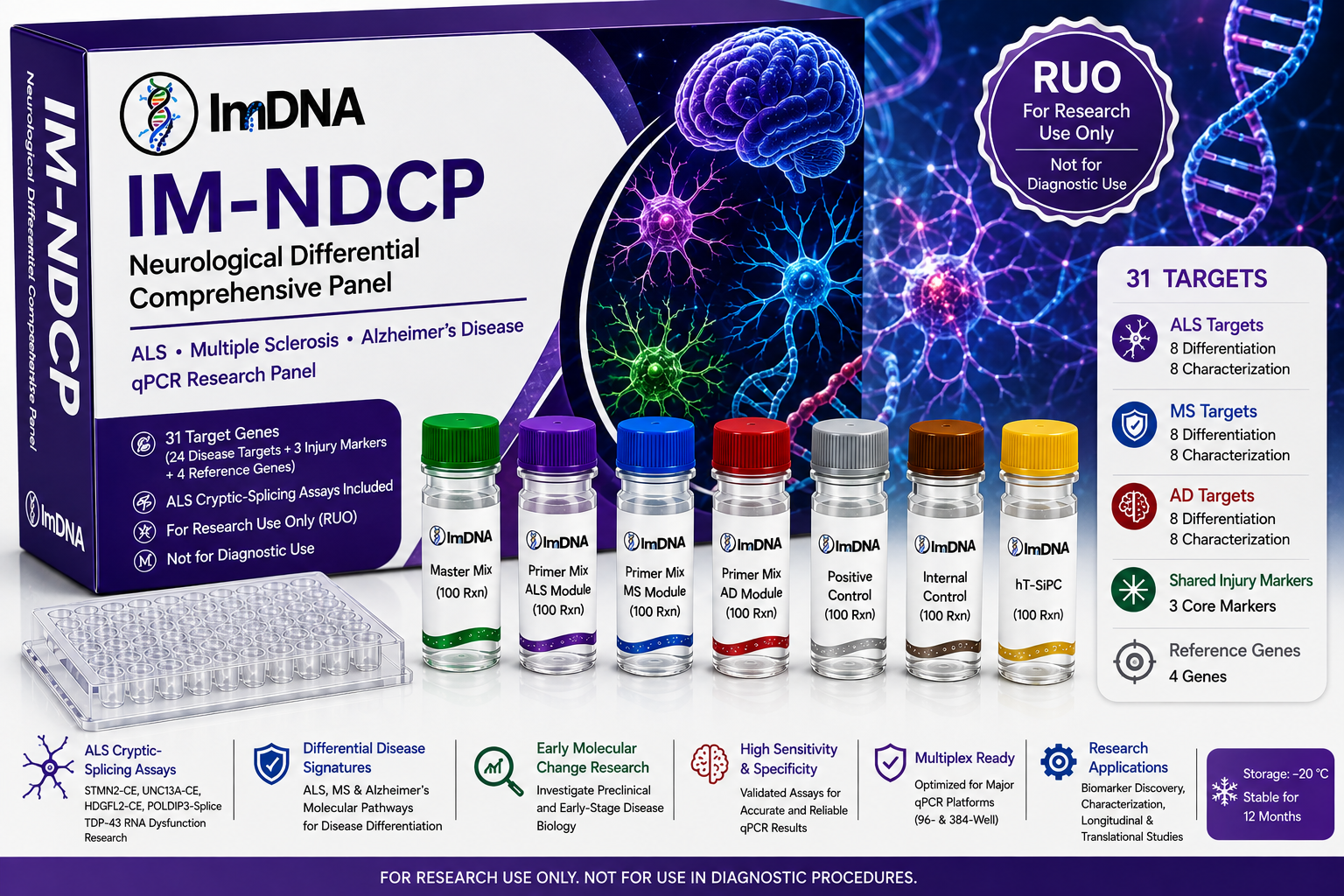
Neurological Differential Comprehensive Panel
Price: Contact us for Quote
IM-NDCP (RUO)
100 Samples (Ready-to-Use Mixes)
Flexible
-
Quality Assurance
Each kit lot is tested for specificity, sensitivity, amplification performance, reproducibility, and lot-to-lot consistency using appropriate research control materials.
-
Applications
Designed for research investigating:
- Amyotrophic lateral sclerosis (ALS) biology
- Multiple sclerosis (MS) biology
- Alzheimer’s disease (AD) biology
- Differential neurological-disease molecular signatures
- Early molecular-change research
- TDP-43-associated RNA-processing dysfunction
- Neuroinflammation and demyelination
- Amyloid and tau pathway biology
- Motor-neuron and axonal degeneration
- Glial and microglial responses
- Disease characterization and molecular subtyping
- Biomarker discovery
- Translational neuroscience research
- Longitudinal disease-progression studies
- Treatment-response research
- Neurological disease-model characterization
-
Storage and Stability
- Store at –20 °C.
- Stable for 12 months from the date of manufacture when stored as recommended.
Neurological Differential Comprehensive Panel: ALS, MS & Alzheimer’s Molecular Research
The IM-NDCP is an RT-qPCR research panel designed for targeted analysis of 27 neurological disease-associated molecular biomarkers plus four reference genes.
Rather than relying on a single neurological marker, IM-Neuro31 organizes biomarkers into complementary disease-associated molecular signatures.
Priority I — Disease-Differentiation Core
ALS / TDP-43 Dysfunction
STMN2-CE, UNC13A-CE, HDGFL2-CE, POLDIP3-Splice
These four transcript-specific assays form the highest-priority ALS research component of the panel.
STMN2-CE
TDP-43-associated cryptic RNA-processing target involved in axonal maintenance, growth, and regeneration.
Loss of normal nuclear TDP-43 activity can result in abnormal STMN2 RNA processing and production of noncanonical transcripts.
Research significance:
TDP-43 dysfunction / motor-neuron and axonal biology.UNC13A-CE
TDP-43-dependent cryptic-splicing target involved in synaptic vesicle release and neuronal communication.
Research significance:
TDP-43 loss-of-function, synaptic dysfunction, and ALS/FTD molecular biology.HDGFL2-CE
TDP-43-dependent cryptic-exon target included as an additional functional indicator of altered RNA-splicing repression.
Research significance:
Functional characterization of TDP-43-associated RNA-processing abnormalities.POLDIP3-Splice
Alternative-splicing assay designed to investigate changes associated with TDP-43 nuclear function.
Research significance:
Independent functional RNA-splicing readout of the TDP-43 pathway.MS / Neuroimmune & Demyelinating Core
CXCL13, IL7R, HLA-DRA, CXCL9
CXCL13
B-cell-attracting chemokine associated with CNS immune activation and intrathecal inflammatory biology.
Research significance:
B-cell recruitment, neuroinflammation, and early inflammatory MS research.IL7R
Interleukin-7 receptor involved in T-cell development, survival, and immune homeostasis and strongly associated with MS biology.
Research significance:
Adaptive immune regulation and MS susceptibility pathways.HLA-DRA
Major histocompatibility complex class II component involved in antigen presentation and immune activation.
Research significance:
CNS immune activation and antigen-presentation pathways.CXCL9
Interferon-responsive chemokine involved in activated immune-cell trafficking.
Research significance:
Inflammatory and T-cell-associated MS biology.Alzheimer’s / Amyloid-Tau-Microglial Core
APP, BACE1, MAPT, TREM2
APP
Encodes amyloid precursor protein.
Research significance:
Amyloid precursor biology and Alzheimer-associated molecular pathways.BACE1
Beta-secretase involved in amyloidogenic processing of APP.
Research significance:
Amyloid-processing pathway characterization.MAPT
Encodes microtubule-associated protein tau.
Research significance:
Tau biology, neuronal cytoskeletal function, and neurodegeneration research.TREM2
Microglial receptor involved in lipid sensing, phagocytosis, inflammatory responses, and responses to neuronal and amyloid-associated injury.
Research significance:
Microglial activation and Alzheimer-associated neuroimmune biology.Priority II — Disease-Characterization Targets
ALS Characterization
TARDBP, KIF5A, SOD1, TBK1
TARDBP
Encodes TDP-43, a major RNA-binding protein regulating transcription, RNA processing, transport, stability, and splicing.
Research significance:
Central ALS/FTD RNA-processing pathway.KIF5A
Kinesin-family motor protein involved in neuronal intracellular transport and long-range axonal trafficking.
Research significance:
Motor-neuron axonal transport and ALS-associated neuronal dysfunction.SOD1
Antioxidant enzyme involved in protection against oxidative stress and one of the best-established genetically associated ALS pathways.
Research significance:
Oxidative-stress and genetically defined ALS research.Note: Total SOD1 expression does not determine SOD1 mutation status.
TBK1
Protein kinase involved in autophagy, innate immune signaling, mitophagy, and interaction with proteins including OPTN.
Research significance:
ALS-associated proteostasis and cellular quality-control pathways.Multiple Sclerosis Characterization
MOG, CHI3L1, IL12B, CXCR3
MOG
Myelin oligodendrocyte glycoprotein expressed in CNS myelin.
Research significance:
Oligodendrocyte and myelin-associated biology.Note: MOG gene-expression analysis is distinct from anti-MOG antibody testing.
CHI3L1
Encodes chitinase-3-like protein 1, also known as YKL-40 at the protein level.
Research significance:
Glial activation, neuroinflammation, and progressive neurological-injury research.IL12B
Encodes the p40 subunit shared by IL-12 and IL-23.
Research significance:
T-cell-associated inflammatory pathways relevant to autoimmune CNS disease.CXCR3
Chemokine receptor associated with activated T-cell trafficking and inflammatory signaling.
Research significance:
Immune-cell recruitment and inflammatory MS biology.Alzheimer’s Disease Characterization
APOE, PSEN1, CLU, ABCA7
APOE
Apolipoprotein involved in lipid transport, neuronal repair, amyloid biology, and microglial responses.
Research significance:
Major Alzheimer-associated lipid and neurodegenerative pathway.Note: APOE gene-expression measurement does not determine APOE ε2/ε3/ε4 genotype.
PSEN1
Component of the γ-secretase complex involved in APP processing.
Research significance:
Amyloid-processing and familial Alzheimer-associated pathways.CLU
Clusterin/apolipoprotein J is involved in lipid transport, protein homeostasis, complement regulation, and amyloid-associated biology.
Research significance:
Amyloid handling, lipid biology, and neuroinflammatory responses.ABCA7
ATP-binding cassette transporter involved in lipid homeostasis, phagocytic biology, and Alzheimer-associated genetic pathways.
Research significance:
Microglial/lipid metabolism and amyloid-clearance research.Priority III — Shared Neurodegeneration & Injury Markers
NEFL, NEFH, GFAP
These targets are intentionally classified as shared injury markers rather than disease-identification markers.
NEFL
Neurofilament light chain is a structural component of neuronal axons.
Research significance:
Axonal injury and neurodegeneration.NEFH
Neurofilament heavy chain contributes to neuronal cytoskeletal organization and axonal structural integrity.
Research significance:
Axonal degeneration and motor-neuron injury.GFAP
Glial fibrillary acidic protein is a major astrocytic intermediate-filament protein.
Research significance:
Astrocyte activation and CNS injury across multiple neurological conditions.Reference Genes
TBP, RPLP0, HPRT1, PPIA
Multiple candidate reference genes are included to support normalization across experimental neurological research samples.
Panel Architecture
ALS — TDP-43 / Motor-Neuron Signature
Primary Differentiation Targets
STMN2-CE
UNC13A-CE
HDGFL2-CE
POLDIP3-SpliceCharacterization Targets
TARDBP
KIF5A
SOD1
TBK1Multiple Sclerosis — Neuroimmune / Demyelination Signature
Primary Differentiation Targets
CXCL13
IL7R
HLA-DRA
CXCL9Characterization Targets
MOG
CHI3L1
IL12B
CXCR3Alzheimer’s Disease — Amyloid / Tau / Microglial Signature
Primary Differentiation Targets
APP
BACE1
MAPT
TREM2Characterization Targets
APOE
PSEN1
CLU
ABCA7Shared Neurodegeneration
NEFL
NEFH
GFAPReference / Normalization
TBP
RPLP0
HPRT1
PPIAComplete IM-Neuro31 Target List
ALS — 8 Assays
STMN2-CE, UNC13A-CE, HDGFL2-CE, POLDIP3-Splice, TARDBP, KIF5A, SOD1, TBK1
Multiple Sclerosis — 8 Targets
CXCL13, IL7R, HLA-DRA, CXCL9, MOG, CHI3L1, IL12B, CXCR3
Alzheimer’s Disease — 8 Targets
APP, BACE1, MAPT, TREM2, APOE, PSEN1, CLU, ABCA7
Shared Neurodegeneration — 3 Targets
NEFL, NEFH, GFAP
Reference Genes — 4 Targets
TBP, RPLP0, HPRT1, PPIA
TOTAL: 31 ASSAYS
27 neurological research biomarkers + 4 reference genes
Suggested Research Interpretation Framework
The IM-Neuro31 panel is designed to support investigation of coordinated molecular patterns rather than interpretation of individual biomarkers in isolation.
ALS TDP-43 Dysfunction Signature
STMN2-CE + UNC13A-CE + HDGFL2-CE + POLDIP3-Splice
Designed to investigate coordinated loss of normal TDP-43-dependent RNA-processing activity.
ALS Characterization Signature
TARDBP + KIF5A + SOD1 + TBK1
Designed to investigate RNA metabolism, axonal transport, oxidative-stress, and proteostasis pathways associated with ALS biology.
MS Neuroimmune Signature
CXCL13 + IL7R + HLA-DRA + CXCL9
Designed to investigate B-cell/T-cell recruitment, antigen presentation, and CNS inflammatory activity.
MS Demyelination/Inflammatory Signature
MOG + CHI3L1 + IL12B + CXCR3
Designed to investigate myelin-associated biology, glial activation, inflammatory signaling, and immune-cell trafficking.
Alzheimer’s Amyloid/Tau Signature
APP + BACE1 + MAPT + PSEN1
Designed to investigate amyloid-processing and tau-associated pathways.
Alzheimer’s Microglial/Lipid Signature
TREM2 + APOE + CLU + ABCA7
Designed to investigate microglial responses, lipid metabolism, amyloid handling, and genetically associated AD pathways.
Neurodegeneration Index
NEFL + NEFH + GFAP
Designed to investigate shared neuronal, axonal, and astroglial injury.